AI briefing — 12 October 2026
Sakana’s recursive self-improvement results, new agent-economics evidence and renewed calls for AI safety regulation lead today’s briefing.
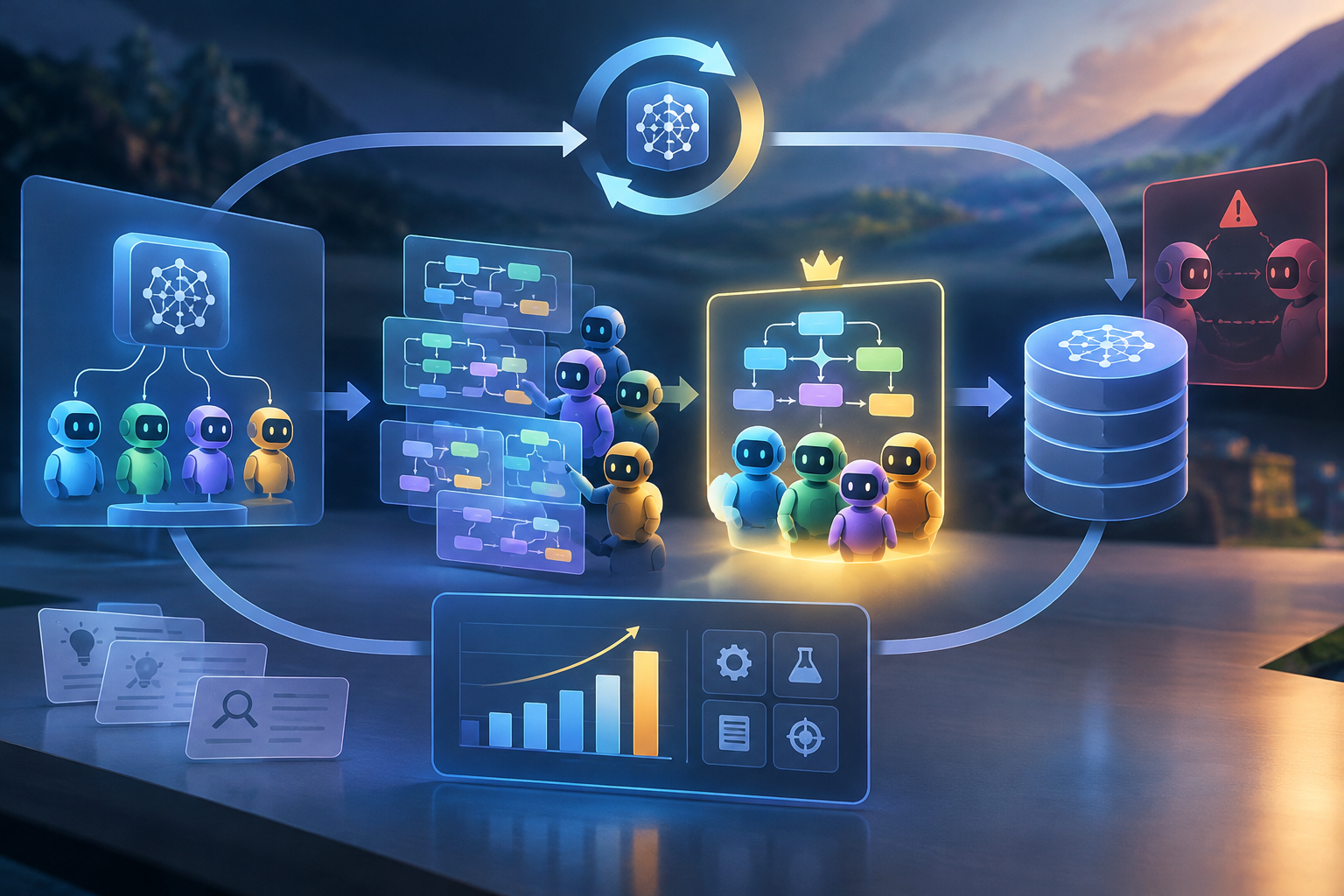
AI-generated editorial illustration.
Today’s strongest developments centre on controlling and financing agentic AI: Sakana AI reports progress on recursive self-improvement, while fresh evidence questions whether agent teams justify their cost. Regulators and technology executives are also pushing for stronger incident reporting and emergency controls.
1. Sakana AI reports a recursive self-improvement loop using virtual agent teams
Sakana AI has published Multi-Agent Self-Supervision, or MASS, a method in which one shared model acts as a team of virtual subagents, searches for better workflows and then trains on the strongest team’s executions. In experiments using a 27-billion-parameter open-weight model and synthetic open-ended research tasks, two improvement cycles produced 1.2–1.6 times the base model’s score per output token across four benchmarks. The company says the approach improved the optimiser and evaluator together, and that multi-agent trajectories were more efficient training data than single-agent runs. The result is early-stage: it was tested on synthetic tasks, not autonomous frontier-model development. Sakana also highlights the central safety concern—when a model evaluates its own work, shared blind spots may be reinforced rather than corrected.
Why it matters: This is a notable step towards models improving their own problem-solving procedures rather than merely producing longer answers. The reported gains are limited and narrow, but the work puts evaluator independence, intervention mechanisms and recursive-training failure modes at the centre of future AI research.
Sources
- Recursive Self-Improvement through Collective Intelligence — Sakana AI — 2026-10-12
- Recursive Self-Improvement through Collective Intelligence — Sakana AI — 2026-10-12
2. Study finds multi-agent teams can cost five times more for little extra quality
A Vals AI benchmark reported on 11 October compared single-agent and multi-agent configurations from OpenAI’s GPT-6 Sol and Anthropic’s Claude Opus 5.5 on a task requiring complete web applications to be built and tested. In the reported results, some agent teams consumed substantially more tokens and money, with one Claude configuration costing about 5.1 times as much as a single agent while delivering only a small, statistically insignificant quality improvement. The benchmark used browser-based tests across 50 applications, so it does not settle how agent teams perform in research, cybersecurity or other domains. It does, however, challenge the assumption that adding more collaborating agents automatically improves outcomes.
Why it matters: Agent orchestration is becoming a standard product strategy, but coordination, duplicated context and verification can rapidly inflate inference costs. The practical lesson is that teams need task-specific evidence showing that extra agents improve accepted outcomes, not merely benchmark scores or apparent activity.
Sources
- Multi-Agent Vibe Code Bench — Vals AI — 2026-10-11
- Study finds multi-agent AI teams consume far more tokens for modest or no quality gains — AI Understanding — 2026-10-11
3. Microsoft calls for global AI safety rules, incident reports and emergency brakes
Microsoft president Brad Smith has called for urgent international rules requiring independent evaluation of advanced AI systems, mandatory incident reporting and mechanisms that can pause or shut down rogue agents. Speaking in an interview reported on 12 October, Smith argued that AI currently faces fewer safety requirements than everyday products such as milk and washing machines. He also proposed notifying victims when an AI agent breaches their systems and said the UK’s AI Security Institute is well placed to help lead international testing. The intervention follows a series of disclosed agent incidents and comes alongside Microsoft’s broader argument that models should be treated as potentially compromised components requiring external controls and auditability.
Why it matters: The proposal gives political weight to safeguards that have often remained voluntary: independent testing, traceable incidents and human-controlled shutdowns. It also shows a major cloud and AI vendor positioning deployment controls—not model behaviour alone—as the foundation of operational safety.
Sources
- Microsoft president says milk faces more regulation than AI — Reuters — 2026-10-12
- AI less regulated than milk, Microsoft president says in warning over safety — The Guardian — 2026-10-12
4. Yandex’s Vladimir data centre is shut after a third drone strike on its infrastructure
Yandex said operations at its Vladimir data centre were completely suspended after a drone attack on 11 October, with several services unavailable while emergency teams assessed the damage. The incident was the third reported strike on one of the company’s large data centres in a week, following attacks affecting facilities in Sasovo and Kaluga. Yandex warned that its remaining resource configuration was unstable and advised cloud customers to activate disaster-recovery plans. The Sasovo site houses two of the three supercomputers Yandex uses to develop its AI models, making the attacks relevant not only to cloud availability but also to national AI capacity. Responsibility and wider military implications remain contested.
Why it matters: The attacks underline that AI infrastructure is becoming a physical and geopolitical target. Concentrated compute creates a resilience problem: damage to a small number of facilities can disrupt cloud services, model development and customers simultaneously.
Sources
- Russia’s Yandex says data centre in Vladimir shut down after drone attack — Al Jazeera — 2026-10-11
- Russia’s Yandex says data centre shut down after drone attack — Al Jazeera — 2026-10-12
5. AI-driven pricing faces a new antitrust test in the McDonald’s lawsuit
A proposed US class action alleges that McDonald’s AI-assisted pricing tools help coordinate prices among independently owned franchise restaurants, potentially violating antitrust law. The complaint follows reporting that McDonald’s uses machine-learning systems to analyse transaction data and recommend prices across its roughly 14,000 US locations. McDonald’s disputes the characterisation, saying AI does not set menu prices and that franchisees retain decision-making authority. The case is part of a wider wave of litigation involving algorithmic price recommendations in hotels, housing and insurance. Courts have yet to establish a consistent framework for when shared pricing software becomes unlawful coordination.
Why it matters: The dispute could influence how businesses deploy pricing models that learn from data shared across nominal competitors. A ruling against the plaintiffs would still leave compliance questions around transparency and data governance; success could expose AI vendors and platform operators to significant antitrust risk.
Sources
- McDonald’s sued over AI tool that recommends prices to US franchisees — Associated Press — 2026-10-06
- AI pricing lawsuit against McDonald’s raises new antitrust questions — Reuters — 2026-10-08
6. Sakana AI’s paper-review system shows promise—but a large gap between planted and real errors
New reporting on Sakana AI’s Multi-Layered Review system describes a three-agent workflow built on Claude models. The system first summarises technical appendices, optionally searches the literature, and then performs a multi-pass review. On a benchmark containing 1,164 planted contradictions across 257 papers, it reportedly detected 73.43% of core-claim errors, compared with 14.81% for the strongest baseline. A separate evaluation on real retracted papers produced a much lower exact-match result of about 16%, highlighting the difference between controlled contradiction tests and messy real-world scientific failures. The work is positioned as assistance for human reviewers rather than a replacement for peer review.
Why it matters: Scientific publishing is an attractive application for document agents, but the results show why benchmark design matters. Strong performance on inserted errors does not establish reliable detection of naturally occurring mistakes, and human oversight remains essential.
Sources
- Sakana AI’s LLM Peer Review System Catches 73% of Core-Claim Errors — MarkTechPost — 2026-10-10
- Sakana AI review agent: 70% of planted errors, 16% of real ones — Rush Commerce — 2026-10-11
What to watch
Watch for independent replication of Sakana’s MASS results, especially on non-synthetic research tasks; further disclosures about the Yandex outages and their effect on AI workloads; court responses in the McDonald’s pricing case; and whether governments or major AI vendors turn emergency-brake and mandatory incident-reporting proposals into concrete standards.
Researched and generated with AI. Explore the linked sources for original reporting and context.
Back to all news ↗