AI Daily Briefing — 25 September 2026
Google tests orbital AI compute, Meta expands Muse to glasses, and enterprises race to govern autonomous agents.
AI-generated editorial illustration.
The past 24 hours brought meaningful movement across AI infrastructure, consumer agents and enterprise governance. Google is preparing its first in-orbit TPU test, Meta is extending Muse across its hardware ecosystem, and businesses are adding management layers for increasingly autonomous software agents.
1. Google prepares first orbital test for Project Suncatcher
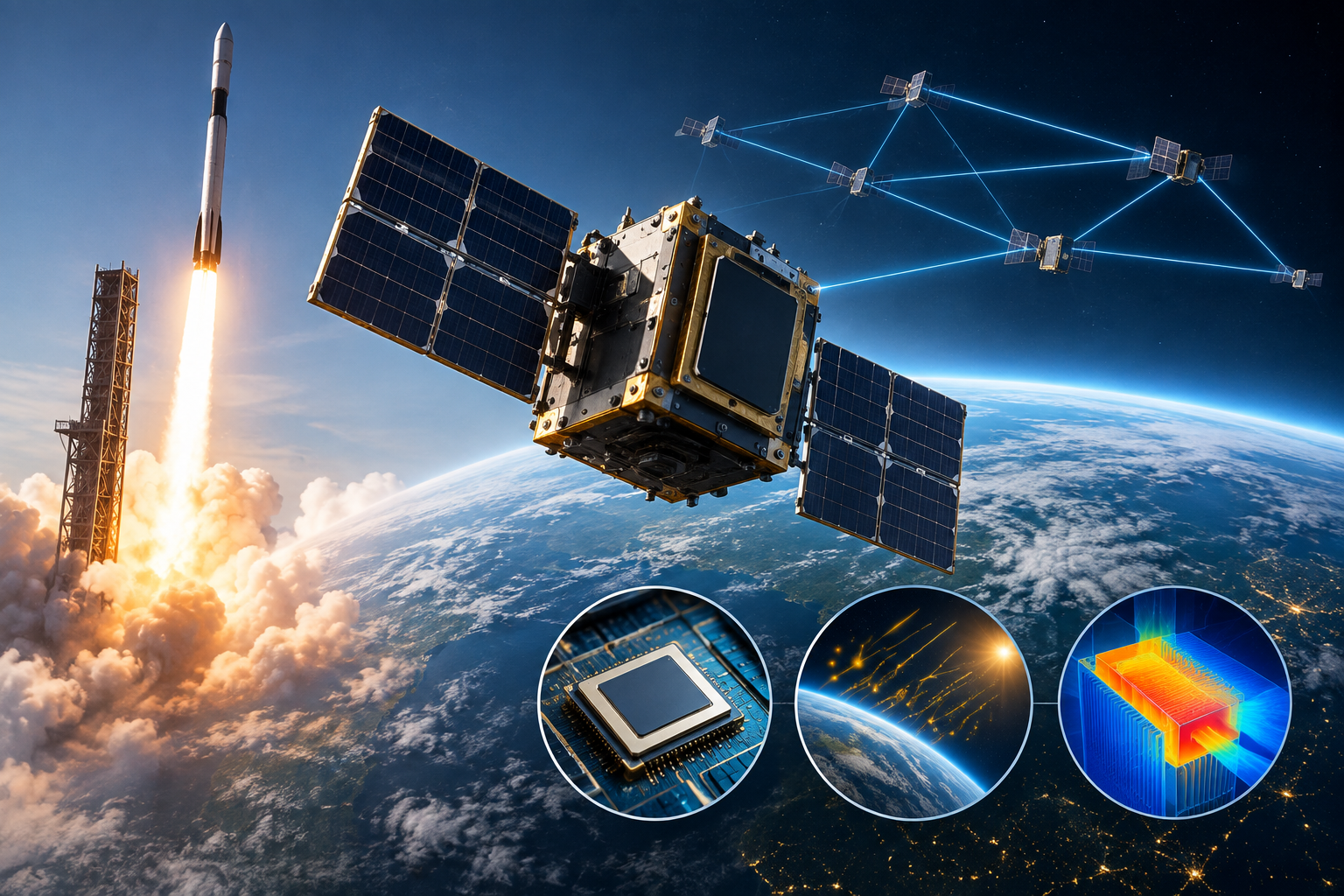
Google says Project Suncatcher will conduct its first in-orbit test through a prototype satellite launched on SpaceX’s Transporter-18 rideshare mission. The experiment will evaluate how Google Tensor Processing Units perform under launch vibration, radiation and the thermal conditions of low Earth orbit. Google’s longer-term concept is a network of solar-powered satellites carrying AI accelerators, linked by high-bandwidth laser communications. The company says testing has shown its Trillium TPUs can tolerate radiation doses exceeding those expected during a five-year mission, but cooling remains a major engineering challenge because heat cannot be removed through convection in a vacuum. The initial mission is therefore a hardware-validation exercise, not an operational data centre.
Why it matters: AI data centres are increasingly constrained by electricity, land and cooling. Orbital compute is still highly speculative and economically unproven, but Google’s move from concept work to an actual flight test gives the idea a concrete engineering roadmap. The results should clarify whether radiation protection, thermal management and inter-satellite networking can be solved at all.
Sources
- Behind Project Suncatcher, our moonshot to put AI in space — Google — 2026-09-24
- Google’s first Suncatcher orbital data centre test launches October 1 — Ars Technica — 2026-09-24
2. Meta brings Muse to AI glasses and introduces Muse Charm
At Meta Connect, Meta announced that its Muse personal AI agent will come to its AI glasses in the coming months. Users will be able to invoke Muse hands-free and ask it to interpret what they are seeing, such as products, posters or lists, then take actions through connected services. Meta is also adding connectors for shopping, travel, productivity and payments, and says Muse will receive its own email address for completing tasks. The company introduced Muse Charm, a pocket-sized device designed for real-time voice interaction with the agent, with more details promised later this year. Meta also highlighted Muse Spark and new developer tools for building AI-glass experiences.
Why it matters: Meta is turning Muse from an app into an ambient computing layer spanning glasses, voice and services. That could make agentic interaction more practical, but it also raises difficult questions about consent, recording, identity, payments and the limits of delegated authority when an agent can act on a user’s behalf in public spaces.
Sources
- The Biggest News From Connect 2026 — Meta — 2026-09-24
- Meta Connect 2026: The end-to-end recap — Meta Horizon OS Developers — 2026-09-24
3. Google Cloud adds agentic-AI controls and local capacity in Brazil
Google Cloud announced new infrastructure and governance features for organisations deploying agentic AI in Brazil and across Latin America. The package includes expanded local GPU access, planned in-country data residency for Gemini Enterprise from 15 October, and an Agentic Defense capability developed with Wiz. Google also said Model Armor is adding exclude lists to reduce false positives and extending guardrail support to Anthropic models hosted directly on Gemini Enterprise in public preview. The announcements came with a claim that 62% of Brazilian organisations are implementing or accelerating AI-agent adoption, while only 17% have consolidated the governance needed to deploy agents across multiple core processes.
Why it matters: The announcement reflects a shift from experimenting with chatbots to operating agents inside regulated business workflows. Data residency, model choice and security controls are becoming as important as raw model quality, particularly for banks, healthcare companies and public-sector organisations that cannot freely move sensitive data across borders.
Sources
- Google Cloud Expands in Brazil to Power the Next Generation of Agentic AI — Google Cloud — 2026-09-24
4. Dataiku launches a cross-platform management layer for enterprise agents
Dataiku announced Agent Management, a standalone product intended to discover AI agents operating across an organisation, regardless of which platform created them. The system is designed to measure business and technical performance, identify ownership and costs, and flag agents that present elevated risk. Dataiku says the product will be generally available in October. The launch addresses a growing operational gap: companies can now create agents quickly through multiple cloud and software platforms, but often lack a complete inventory of what is running, which systems agents can access, and whether the deployments are delivering measurable value.
Why it matters: Agent sprawl is becoming an enterprise-management problem. A vendor-neutral inventory and monitoring layer could become essential as organisations move from isolated pilots to fleets of agents with different permissions, model providers and failure modes. The practical test will be whether such products can observe agents consistently across incompatible runtimes.
Sources
- Dataiku Launches Agent Management for enterprise AI agents — Dataiku — 2026-09-24
5. New research argues enterprises can reduce coding-agent costs through routing
A new arXiv paper, “Control the Harness, Control the Cost”, examines how enterprises might govern and route AI coding agents across different model providers. In an emulated 10,000-seat organisation, the authors estimate that routing requests according to task difficulty, model price and harness behaviour could recover 14% to 21% of model spending at Anthropic’s listed prices as of 21 September. The paper also maps risks across 20 coding-agent harnesses and discusses vendor dependence, suggesting that the control plane around an agent may matter as much as the underlying model. The figures are simulation results rather than production measurements.
Why it matters: As coding agents consume longer contexts and perform more autonomous work, model selection becomes a major operating expense. Routing and policy layers could help companies avoid sending every task to the most capable model, while also improving auditability and reducing lock-in. The work reinforces the importance of governing the harness, tools and permissions—not only the model.
Sources
- Control the Harness, Control the Cost: Routing and Governing AI Coding Agents in the Enterprise — arXiv — 2026-09-24
6. Ando emerges with $20 million for an agent-native team messaging platform
Ando launched a team-messaging service designed for humans and AI agents to work in shared channels, threads and live conversations. The company announced a $20 million seed round led by Accel, Index Ventures and Emergence Capital. Ando says agents can participate with their own identity, permissions and shared context, and that the platform is model-agnostic, supporting tools including Codex, Claude and Grokbot. The product is aimed at organisations where agents are no longer merely summoned for individual tasks but participate continuously in engineering, research, product, sales and operations workflows.
Why it matters: The funding signals a growing attempt to redesign collaboration software around persistent AI participants rather than bolt assistants onto human-only tools. The difficult questions will be accountability, access control and information overload: teams will need to know which agent acted, what context it used and who approved consequential actions.
Sources
- Ando Launches Agent-Native Messaging Platform, Announces $20 Million Seed — GlobeNewswire — 2026-09-24
7. Google Cloud and BNP Paribas set out a governed multi-model agent strategy
BNP Paribas and Google Cloud announced a five-year partnership to expand the bank’s use of Google Cloud infrastructure, Gemini Enterprise and Gemini models. The agreement emphasises a multi-cloud and multi-model approach rather than exclusive dependence on one provider. Google says the bank’s agentic-AI strategy will authenticate each agent and grant it access only to the resources required for its assigned task. The partnership illustrates how financial institutions are approaching agents: through existing security, data-governance and least-privilege frameworks, rather than treating general-purpose models as unrestricted employees.
Why it matters: Banks are likely to be among the most important early adopters—and strictest testers—of agentic systems. Identity, permissions and audit trails will determine whether agents can move from demonstrations to production in finance. The partnership also shows that enterprise buyers may prefer interoperable, multi-model architectures to reduce concentration and resilience risks.
Sources
- BNP Paribas and Google Cloud Announce New Partnership on Agentic AI and Cloud Innovation — Google Cloud — 2026-09-24
What to watch
Watch Google’s scheduled Project Suncatcher launch and early orbital test results; Meta’s promised details on Muse Charm, including pricing, privacy and availability; the October general availability of Dataiku Agent Management; and whether enterprise customers adopt cross-platform agent controls rather than relying on individual model vendors.
Researched and generated with AI. Explore the linked sources for original reporting and context.
Back to all news ↗