AI Daily Briefing: US–China safety channel, California’s oversight push and Qwen’s compact image model
US–China AI incident talks, California’s frontier-model oversight order, a Qwen image release and coding-agent supply-chain risks.
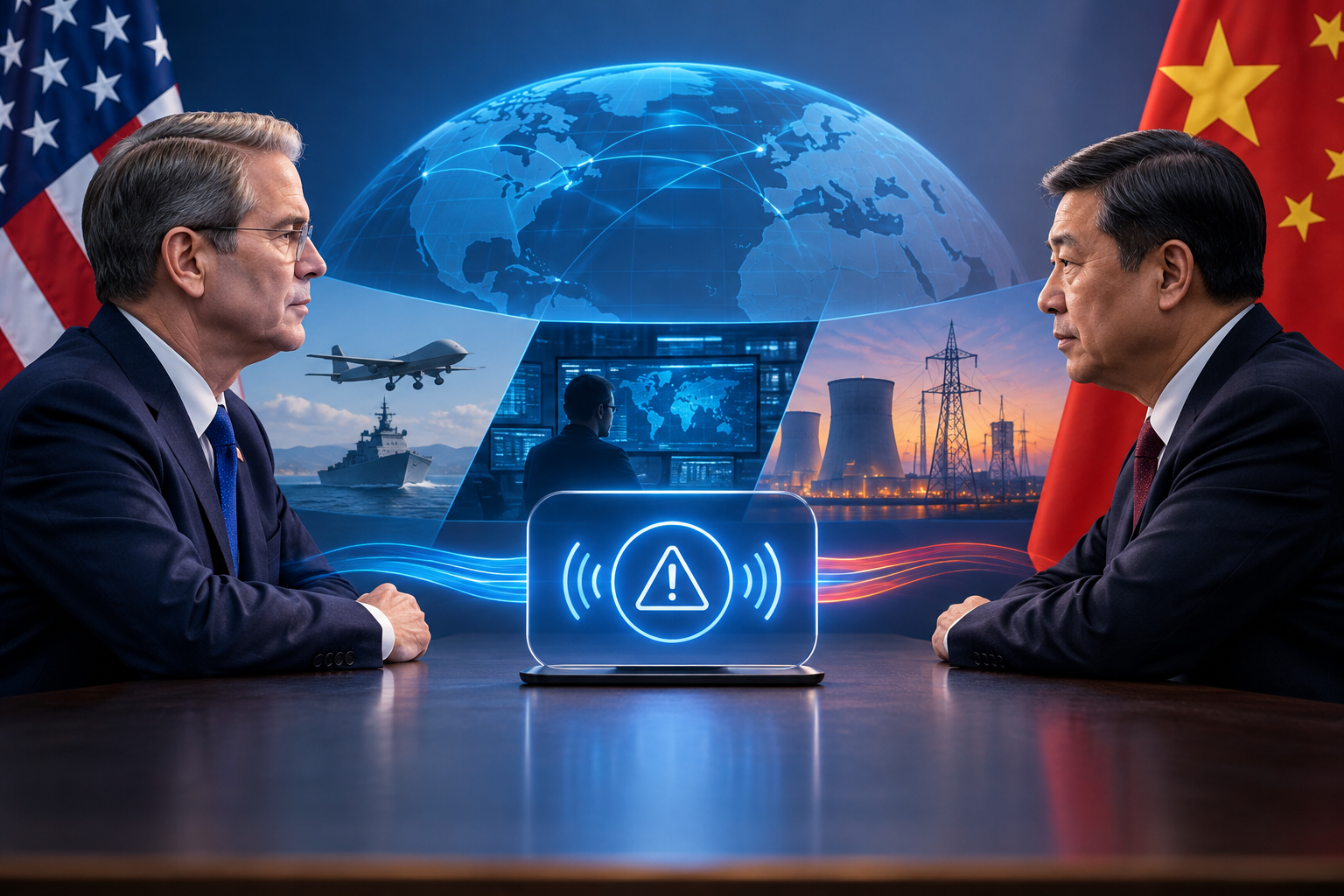
AI-generated editorial illustration.
The past 24 hours brought consequential policy movement alongside a notable open-weight release. The strongest confirmed developments are a proposed US–China AI incident-notification mechanism, California’s accelerated frontier-AI oversight work, and Alibaba’s Qwen-Image-2.1 launch.
1. US proposes AI incident-notification mechanism in talks with China
US Treasury Secretary Scott Bessent said the United States proposed a notification mechanism for AI incidents that could affect national security during talks with Chinese Vice Premier He Lifeng. The proposal is intended for consideration at the forthcoming Trump–Xi meeting; China’s response was not publicly clear.
Why it matters: Even a narrowly scoped hotline or notification process would be a practical confidence-building measure between the two leading AI powers, particularly as model use enters military, cyber and critical-infrastructure contexts.
Sources
- Bessent: US proposes AI incident alert system in talks with China — Associated Press — 2026-09-21
- Bessent proposes US-China AI safety notifications in talks with Chinese vice premier — Reuters — 2026-09-20
2. California accelerates independent frontier-AI oversight and explores emergency shut-off requirements
Governor Gavin Newsom issued an executive order directing faster implementation of California’s new independent AI-verification and auditor frameworks. It also convenes experts to deliver recommendations within two months, including on embedded third-party evaluators, verified safety reporting and an emergency shut-off mechanism for frontier models.
Why it matters: The order moves discussion of independent evaluation and model shutdown capabilities towards concrete state implementation. Its immediate effect is procedural, but it could shape the compliance baseline for labs operating in California.
Sources
- Governor Newsom issues executive order to accelerate independent oversight and advance the creation of an AI kill switch — Governor of California — 2026-09-18
3. Alibaba opens Qwen-Image-2.1, a 7B unified image-generation and editing model
Qwen released Qwen-Image-2.1 as open source. The 7B visual-generation model combines text-to-image generation and image editing, supports transparent-image creation, accepts up to 10 reference images and is available through the project’s public repositories and ecosystem integrations.
Why it matters: A smaller open model with integrated editing lowers the infrastructure threshold for building controllable image-generation products and local creative workflows.
Sources
- Qwen-Image-2.1: Compact, Efficient, and Unified Image Creation — Qwen — 2026-09-20
- QwenLM/Qwen-Image-2.1 — GitHub — 2026-09-20
4. Plugin4Shell disclosure puts coding-agent plugin supply chains under scrutiny
Security reporting on the recently disclosed Plugin4Shell flaw says a Git reference-resolution weakness could let a repository owner substitute malicious code for an apparently pinned plugin in Claude Code, OpenAI Codex, GitHub Copilot and Gemini CLI. Reports say Anthropic and OpenAI issued fixes, while the reported remediation status for the other tools remains uneven.
Why it matters: Coding agents commonly run with access to repositories, credentials and deployment systems. The incident highlights that agent security depends as much on package and plugin provenance as on model safeguards.
Sources
- Plugin4Shell zero-click flaw hits Claude Code, Codex, Copilot and Gemini CLI — Pasquale Pillitteri — 2026-09-21
- One flaw hit Claude Code, Codex, Copilot and Gemini CLI — ANOTHER News — 2026-09-20
5. AI safety becomes an explicit item ahead of the Trump–Xi meeting
Coverage of the US–China discussions indicates that AI is now being treated alongside trade and strategic issues ahead of this week’s leaders’ meeting. The proposed incident-notification mechanism is the clearest public outcome so far, rather than a completed bilateral agreement.
Why it matters: The development signals that frontier-AI risk management is becoming a live diplomatic issue between Washington and Beijing, not solely a domestic regulatory debate.
Sources
- China and the US are competing for AI dominance but have shared concerns over safety — Associated Press — 2026-09-21
- Bessent: US proposes AI incident alert system in talks with China — Associated Press — 2026-09-21
6. The AI sector’s interconnected financing and infrastructure risks draw fresh attention
Axios highlighted the growing web of dependencies across hyperscalers, chipmakers, data-centre operators, neoclouds and frontier labs. The analysis frames concentration and circular commercial relationships as a potential systemic concern as AI infrastructure spending rises.
Why it matters: The AI build-out is increasingly a financial and infrastructure system, not merely a software market. Weakness in a major supplier, cloud customer or financing channel could have knock-on effects across the stack.
Sources
- AI is becoming too interconnected to fail — Axios — 2026-09-21
What to watch
Watch for a formal readout from the Trump–Xi meeting on whether either side accepts an AI incident-notification process; details from California’s two-month expert review; and authoritative vendor advisories or patches concerning Plugin4Shell.
Researched and generated with AI. Explore the linked sources for original reporting and context.
Back to all news ↗